

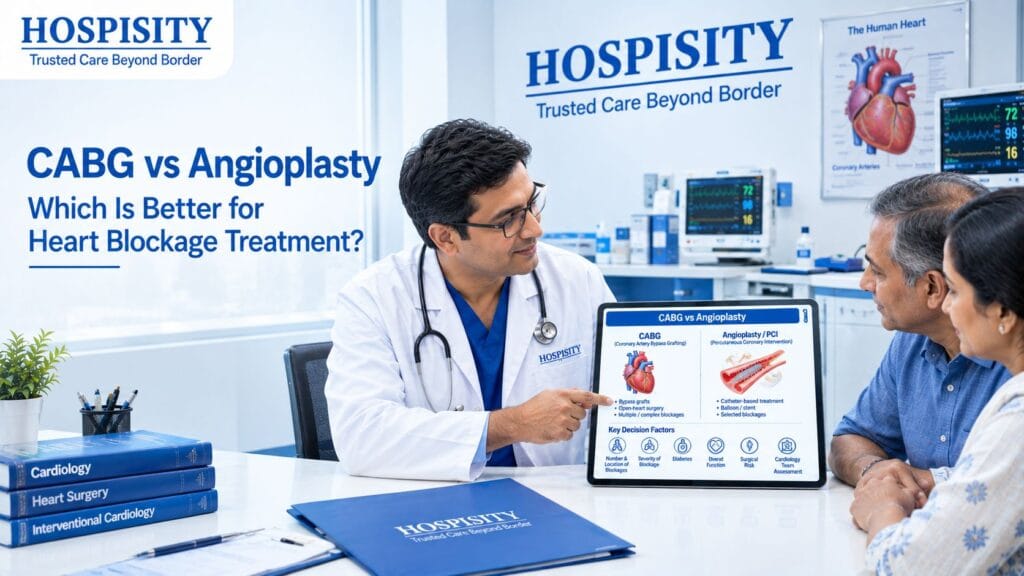
CABG vs Angioplasty: Which Is Better for Heart Blockage Treatment?
Heart blockage is one of the most common and serious heart conditions worldwide. Yet when patients are told they need treatment, confusion often follows. Doctors may suggest bypass surgery or angioplasty, and both options can sound overwhelming.
So how do you decide?
Let’s simplify this in a clear, patient-friendly way so you can understand what each treatment does, when it’s used, and what it means for your long-term health.
CABG is usually better for patients with multiple or complex blockages, offering long-term durability. Angioplasty is ideal for single or less severe blockages, with quicker recovery. The right choice depends on the severity of disease, overall health, and long-term risk factors.
Quick Summary
- CABG is preferred for severe or multiple artery blockages
- Angioplasty is less invasive and suits simpler cases
- Bypass surgery offers longer-lasting results in many patients
- Angioplasty has faster recovery but may need repeat procedures
- The best treatment depends on individual health, not just the blockage
What Is Heart Blockage and Why Treatment Matters
Heart blockage happens when the arteries supplying blood to your heart become narrowed or blocked due to plaque buildup. This process is called coronary artery disease.
Over time, reduced blood flow can cause chest pain, breathlessness, or even a heart attack.
Here’s the key concern. Once a blockage becomes significant, medications alone may not be enough. That’s when procedures like CABG or angioplasty are recommended to restore blood flow.
Ignoring treatment can increase the risk of life-threatening complications. Acting at the right time can improve both survival and quality of life.
What Is CABG Surgery?
CABG stands for Coronary Artery Bypass Grafting.
In simple terms, it is an open-heart surgery where doctors create a new pathway for blood to flow around blocked arteries. They use a healthy blood vessel from another part of your body to bypass the blockage.
This allows oxygen-rich blood to reach the heart muscle again.
CABG is typically recommended when:
- Multiple arteries are blocked
- Blockages are severe or complex
- Previous angioplasty has failed
- The patient has diabetes with extensive disease
It is a major surgery, but it offers strong long-term results for many patients.
What Is Angioplasty?
Angioplasty is a minimally invasive procedure.
A thin tube is inserted through a blood vessel, usually in the wrist or groin, and guided to the blocked artery. A small balloon is inflated to open the blockage, and a stent is placed to keep the artery open.
There is no open surgery involved.
Angioplasty is often used when:
- There is a single or limited blockage
- The blockage is less complex
- Immediate treatment is needed during a heart attack
The biggest advantage is quicker recovery and less physical trauma.
CABG vs Angioplasty: Key Differences
| Feature | CABG | Angioplasty |
| Procedure | Open-heart surgery | Minimally invasive |
| Success Rate | More durable long-term | Effective in short to mid-term |
| Recovery | Longer healing period | Faster recovery |
| Cost | Higher upfront cost | Lower initial cost |
| Risk | Surgical risks present | Lower immediate risk |
| Repeat Procedure | Repeat Procedure | More likely in some cases |
Transparent Pricing for Better Healing.
We believe that great care starts with trust. That’s why we ensure complete transparency in our treatment pricing—no surprises, no hidden fees, just honest and clear costs for the care you deserve.
Success Rate Comparison
When patients ask about outcomes, they are really asking one thing. Which treatment will last longer?
CABG is often more durable. It creates a new route for blood flow, which reduces the chance of future blockage in the same area.
Angioplasty, on the other hand, treats the blockage directly. While stents are effective, there is a chance the artery may narrow again over time.
So what does this mean for patients?
If you have multiple blockages or high-risk conditions, CABG often provides better long-term protection. For simpler cases, angioplasty works well and avoids major surgery.
Cost Comparison
Cost is an important factor, especially for international patients.
In India, treatment is significantly more affordable compared to Western countries while maintaining high medical standards.
Patients often explore CABG Surgery Cost in India when considering bypass surgery. The cost depends on hospital, surgeon expertise, and complexity of the case.
Similarly, Angioplasty Surgery Cost in India is generally lower because it is less invasive and requires shorter hospital stays.
However, here’s something many patients overlook.
CABG may cost more initially but can reduce the need for future procedures. Angioplasty may seem cheaper upfront but could require repeat interventions.
So the real question is not just cost today, but cost over time.
Recovery Differences
Recovery is one of the biggest concerns for patients.
CABG involves opening the chest, so healing takes time. Many patients ask about recovery time after CABG surgery, which typically ranges from 6 to 12 weeks depending on overall health.
During this period, patients gradually regain strength, and cardiac rehabilitation plays a key role.
Angioplasty recovery is much faster. Most patients go home within a day or two and return to normal activities within a week.
But speed is not everything.
CABG recovery may be longer, but it often provides more lasting relief. Angioplasty offers quick recovery, but lifestyle changes remain essential to prevent recurrence.
Risks and Complications
Every medical procedure carries some risk.
CABG, being a major surgery, has risks such as infection, bleeding, or complications related to anesthesia. Patients often want to understand the risks of CABG surgery, especially if they are older or have other health conditions.
Angioplasty has fewer immediate risks but can include:
- Re-narrowing of the artery
- Blood clots in the stent
- Need for repeat procedures
Here’s the key takeaway. CABG carries higher short-term risk but often fewer long-term issues. Angioplasty is safer upfront but may require future interventions.
Which Is Safer?
Safety depends on timing and patient condition.
For stable patients with simple blockages, angioplasty is generally safer due to its minimally invasive nature.
For patients with complex disease, CABG may actually be safer in the long run because it provides a more complete solution.
So safety is not about the procedure alone. It’s about choosing the right procedure for the right patient.
Which Is Better for Different Patients?
There is no one-size-fits-all answer.
Doctors consider several factors:
- Number of blocked arteries
- Severity of blockage
- Age and overall health
- Presence of diabetes or other conditions
Let’s simplify this.
CABG is usually better for:
- Multiple blockages
- Severe coronary artery disease
- Diabetic patients with complex disease
Angioplasty is better for:
- Single or mild blockages
- Patients needing quick recovery
- Emergency situations like heart attack
So when asking CABG or angioplasty which is better, the answer depends entirely on your specific condition.
CABG vs Angioplasty for Diabetics
Diabetes changes the equation.
Patients with diabetes often have more diffuse and complex artery disease. In these cases, CABG tends to provide better long-term outcomes.
Angioplasty may still be used, but the chances of recurrence are higher.
This is why many cardiologists recommend bypass surgery for diabetic patients with multiple blockages
Modern Advancements in Treatment
Heart treatment has improved significantly in recent years.
One major advancement is minimally invasive CABG surgery. This technique uses smaller incisions and avoids opening the chest completely in selected patients.
Benefits include:
- Reduced pain
- Faster recovery
- Lower risk of infection
Similarly, angioplasty has advanced with better stents that reduce the risk of re-narrowing.
These innovations are helping patients recover faster while maintaining strong outcomes.
Life After Treatment
Treatment is only one part of the journey.
What truly matters is how you live afterward.
Patients often wonder about life after bypass surgery. The good news is that most people return to a normal, active life.
However, both CABG and angioplasty require lifestyle changes:
- Healthy diet
- Regular exercise
- Smoking cessation
- Stress management
Here’s the truth. Surgery fixes the blockage, but lifestyle prevents it from coming back.
Why Patients Choose India
India has become a global hub for cardiac treatment.
Patients choose India for several reasons:
- Affordable treatment costs
- Highly experienced cardiac surgeons
- Advanced hospital infrastructure
- Short waiting times
Many hospitals follow international protocols and offer outcomes comparable to top global centers.
Medical Tourism Support by Hospisity
Planning treatment in another country can feel overwhelming.
Many international patients rely on Hospisity for structured support during cardiac treatment planning and recovery coordination.
This includes:
- Personalized treatment planning
- Selection of the right hospital and doctor
- Visa assistance
- Travel and accommodation arrangements
- Dedicated patient coordinators
This support helps patients focus on recovery instead of logistics.
Conclusion
Choosing between CABG vs angioplasty is not about which treatment is universally better. It is about which one is better for you.
CABG offers long-term durability and is ideal for complex cases. Angioplasty provides quicker recovery and works well for simpler blockages.
The best decision comes from understanding your condition, discussing options with your doctor, and considering both short-term and long-term outcomes.
Here’s the final takeaway.
The right treatment is the one that gives you the safest and most sustainable path to a healthier heart.
Frequently Asked Questions (FAQs)
CABG generally lasts longer because it creates a new pathway for blood flow. Angioplasty treats the existing artery, which may narrow again over time. For complex cases, bypass surgery often provides more durable results.
Yes, there is a chance of re-narrowing, especially in certain patients. Modern stents reduce this risk, but it is not completely eliminated. Regular follow-up and lifestyle changes are important.
Doctors evaluate imaging tests, number of blockages, patient health, and risk factors. A heart team approach is often used to recommend the best treatment for each individual.
Angioplasty is less invasive and has lower immediate risk. However, CABG may be safer long-term for patients with severe or multiple blockages. Safety depends more on the patient’s condition than the procedure itself.
Yes. Hospisity offers free medical opinions and cost estimates once you share your medical reports. This helps you plan your travel, budget, and treatment options with clarity.
CABG usually takes 3–6 hours, depending on the number of grafts.
Success rates are high, with most patients experiencing long-term relief from symptoms.
Typically, 1–4 arteries may be bypassed depending on blockage severity.
You can choose from private hospital rooms, nearby hotels, serviced apartments, or guest houses. Hospisity helps you book safe, affordable accommodation for you and your attendant.
No. Payments are usually made after arrival at the hospital, except in cases where advance admission or special preparation is required. Hospisity will guide you transparently.
You can send reports via WhatsApp, email, or secure upload. Hospisity ensures your documents reach the right specialists for evaluation within 24–48 hours.
You should bring:
- Passport & medical visa
- Previous medical records and prescriptions
- Imaging CDs/scans
- Medical summaries
- Your local doctor’s consultation notes
Hospisity will provide a checklist to make travel easier.
Yes, in rare cases, repeat bypass surgery may be required if new blockages develop.
CABG recovery involves discomfort due to the surgical incision, but pain is managed with medication. Most patients gradually improve over several weeks and regain normal function with rehabilitation.
CABG offers long-term relief but is not a cure. New blockages can develop if lifestyle changes are not followed. Ongoing care is essential for lasting results.
Most patients return to normal activities within a week. Light activities can start within a few days, but heavy exertion should be avoided until your doctor advises.
It depends on overall health. Angioplasty is often preferred for frail elderly patients due to lower surgical stress. However, CABG may still be recommended if the disease is severe.
Yes. Medications such as blood thinners, cholesterol-lowering drugs, and blood pressure medications are usually required after both CABG and angioplasty to prevent future complications.
Lifestyle changes help slow disease progression but may not reverse significant blockages. Once blockage is severe, procedures like CABG or angioplasty are often necessary.